10 Content Repurposing Strategies That Actually Work in 2026

In brief
Content repurposing turns one asset into many by reformatting it for different platforms and audiences. The strategies that work adapt each piece natively (aspect ratio, length, hook) and keep each output unique enough to avoid duplicate-detection suppression, so one idea can fuel weeks of posts.
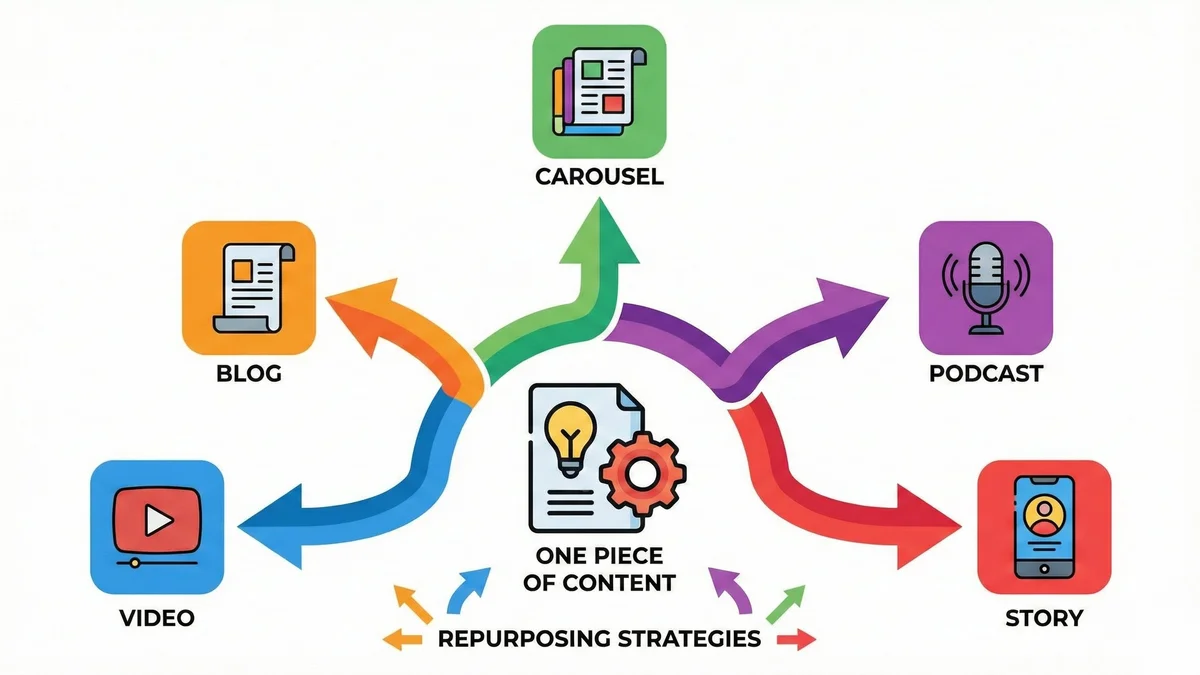
Creating content is time-consuming and expensive. The smartest content creators and brands do not create something new for every platform and every post. Instead, they repurpose: taking one piece of content and transforming it into multiple formats, angles, and variations.
Repurposing, Reposting and Cross-Posting: What Changes?
- Content repurposing: adapt an existing idea into a different format or angle, such as turning a tutorial into a short video that answers one question.
- Reposting: share an existing post again, using a platform's sharing feature or preparing a new upload.
- Cross-posting: distribute content across several platforms. Our cross-posting guide covers that publishing workflow.
These approaches can work together: repurpose a video into focused clips, then adapt and cross-post those clips for each audience.
Repurposing comes with a hidden risk: platforms are increasingly aggressive at detecting duplicate and near-duplicate content, even across different formats.
Here are 10 repurposing strategies that actually work in 2026, along with how to ensure each version is treated as unique.
1. Long-Form Video to Short Clips
Take a 10-minute YouTube video and extract 3-5 high-impact moments as 30-60 second clips for TikTok, Instagram Reels, and YouTube Shorts. Each clip should focus on one hook or one takeaway that stands alone.
The challenge: platforms can detect when a clip is extracted from a longer video that exists elsewhere. The visual fingerprint of those frames is already in the database from the original upload.
2. Podcast Episode to Audiogram
Pull the most compelling 60-90 second segment from a podcast episode. Pair it with a waveform animation, captions, and a branded background to create an audiogram that works as a Reel or TikTok. The visual element makes audio content shareable on video-first platforms.
3. Blog Post to Carousel
Transform a written blog post into a 7-10 slide Instagram carousel. Each slide presents one key point with clean typography and a consistent visual style. Carousels consistently outperform single images in saves and shares, which are the engagement signals Instagram weights most heavily.
4. Horizontal to Vertical
Reformat 16:9 landscape content (YouTube, desktop) into 9:16 vertical format (TikTok, Reels, Stories, Shorts). This is not just cropping. You need to reframe the content to ensure the important elements are centered in the vertical frame. Consider adding text overlays and captions that fill the additional vertical space.
The detection risk here is significant: the visual content within the frame is identical, just reframed. Platforms check for this specific transformation.
5. Tutorial to Infographic
Condense a step-by-step tutorial video or blog post into a single infographic image. This works especially well on Pinterest, LinkedIn, and as an Instagram single-image post. Infographics are among the most saved and shared content types.
6. Webinar to Highlight Reel
Take a 60-minute webinar or live stream and create a 2-3 minute highlight reel with the most valuable moments. Add transitions, captions, and a call to action. This compressed version works as standalone content while driving traffic to the full recording.
7. Customer Testimonial to Multiple Formats
A single customer testimonial video can become: a short clip for social media, a quote graphic for Instagram, a case study for LinkedIn, a screenshot for your website, and an audiogram for podcast promotion. One authentic piece of social proof, five different content pieces. Brands that rely heavily on customer content should also explore how to repurpose user-generated content for maximum impact.
8. Tweet Thread to Video Script
Viral tweet threads are already structured as compelling narratives. Turn them into a narrated video with supporting visuals, or into a talking-head video that walks through each point. The content is proven (it already went viral in text form), so the video version has a high probability of performing well too.
9. Behind-the-Scenes to Story Series
Take behind-the-scenes footage or process documentation and turn it into a multi-part Story series. This works particularly well on Instagram Stories and Snapchat, where the ephemeral, casual format makes raw footage feel authentic rather than unpolished.
10. Evergreen Content Refresh
Take your best-performing content from 3-6 months ago and re-release it with updated information, a new thumbnail, and refreshed captions. Most of your current audience never saw the original. Evergreen content can be cycled indefinitely with minor updates.
This is the highest-risk strategy for detection: you are literally re-uploading the same content to the same platform. Without proper modification, the platform will immediately flag it as a duplicate.
How to Repurpose a Video: A Practical Example
Imagine you have a ten-minute product tutorial. Instead of repeating the whole demonstration, turn it into three useful videos: a quick answer to a common question, a walkthrough of one feature, and a mistake to avoid. Each should make sense without watching the original.
- Choose one takeaway per clip. Cut the introduction and open with the question or result the viewer cares about.
- Adapt the frame and captions. Keep the subject visible in a vertical crop and preview text placement in each app so buttons and captions do not cover it.
- Prepare and check your versions. MetaGhost fits the file-preparation stage of this workflow. Review each exported variant for framing, readable text and audio before uploading.
- Match the publication to its audience. Write a relevant title or caption for TikTok, Instagram Reels or YouTube Shorts. Use our multiplatform publishing guide to organize the uploads.
Check the destination's current format guidance: YouTube documents square or vertical Shorts up to three minutes. For paid creative, TikTok recommends vertical 9:16 video and keeping key elements inside the interface safe zone. The TikTok source concerns ads; it is not a rule about organic ranking.
The Detection Risk in Content Repurposing
Every repurposing strategy above involves reusing visual or audio content that already exists somewhere online. Platforms do not care that you are the original creator or that the format is different. Their detection systems compare the underlying visual features:
- Same frames, different crop: Detected. The visual fingerprint of the core content is unchanged.
- Same video, shorter clip: Detected. The frames that exist in both versions produce matching fingerprints.
- Same content, different platform: Often detected. Meta, Google, and TikTok share some fingerprint data and all use similar AI models.
- Same content re-uploaded months later: Detected. Fingerprint databases are permanent.
The result: your repurposed content gets reduced reach, shadowbanned, or removed, even though it is your own content and you are just adapting it for a different format or audience.
Making Each Version Truly Unique
Surface-level edits do not solve this problem. Adding a filter, changing the speed by 5%, or mirroring the video does not fool AI detection models that analyze deep visual features.
To make repurposed content truly unique, you need modifications at the level these systems actually analyze:
- File metadata (device signatures, timestamps)
- Visual fingerprint (pixel-level changes that survive compression)
- AI feature representation (adversarial perturbations that change how detection models interpret the content)
If you are distributing to multiple platforms, a solid cross-posting strategy is essential alongside the technical modifications.
The MetaGhost Approach to Repurposing
MetaGhost makes content repurposing safe and scalable. Process each version of your content through MetaGhost before uploading, and every platform sees it as completely original material, even if the same source content has already been uploaded elsewhere in a different format.
Take one piece of content, create 10 variations across different platforms and formats, and have every single version treated as unique. No reduced reach, no shadowbans, no content removal.
Ready to multiply your content output without the detection risk? Get started with MetaGhost and make every repurposed piece undetectable.
Sources and documentation
YouTube Help
Understand three-minute YouTube ShortsCurrent aspect-ratio and duration guidance for Shorts uploads.
TikTok for Business
Creative best practices for performance adsVertical framing and interface safe zones for ads. This source does not establish organic ranking or detection-bypass results.
Frequently Asked Questions
What does repurposing content mean?
Taking a single piece of content and adapting it into multiple formats or platform-native versions, so one idea produces many posts.
Does repurposing trigger duplicate detection?
It can if the files are identical. Reformatting and uniquifying each version keeps them from being flagged as recycled.
What content is best to repurpose?
Your highest-performing pieces, since they have already proven they resonate. Reformatting them for other platforms extends their reach.
Help us improve
Did this guide solve your problem?
Ready to create your next repost?
Try MetaGhost and make every repost unique and undetectable.
Discover MetaGhostRelated Articles
How to Build a Faceless Social Media Brand in 2026
How to create and grow a faceless brand on social media. Content sourcing strategies, tools, and how to bypass repost detection at scale.
The Complete Guide to Cross-Posting on Social Media in 2026
How to cross-post across Instagram, TikTok, Facebook and more without triggering duplicate detection. Best practices and how to make each version unique.
UGC Content: How to Repurpose User-Generated Content Legally
What UGC is, the legal framework for repurposing user-generated content, how to collect it at scale, and how to solve duplicate detection issues.
How to Post the Same Content on Multiple Platforms
Why cross-posting triggers duplicate detection, how platforms share fingerprint databases, and techniques to make each upload unique per platform.
How to Grow a Theme Page on Instagram in 2026
Build a profitable Instagram theme page from scratch: curate viral content, avoid duplicate detection, and scale to thousands of followers.
How to Run 20 Instagram Accounts Without One Link Banning Them All (2026/2027 Guide)
Here is how the mechanism works, why it takes down accounts in groups, and the setup that keeps them separate.