How to Build a Faceless Social Media Brand in 2026

In brief
A faceless brand grows on a consistent niche, a recognizable visual identity and a repeatable content system rather than a personal face. Pick one clear theme, standardize your format and posting cadence, repurpose content across platforms, and route your audience through a single link-in-bio hub. Consistency and volume matter more than showing yourself.
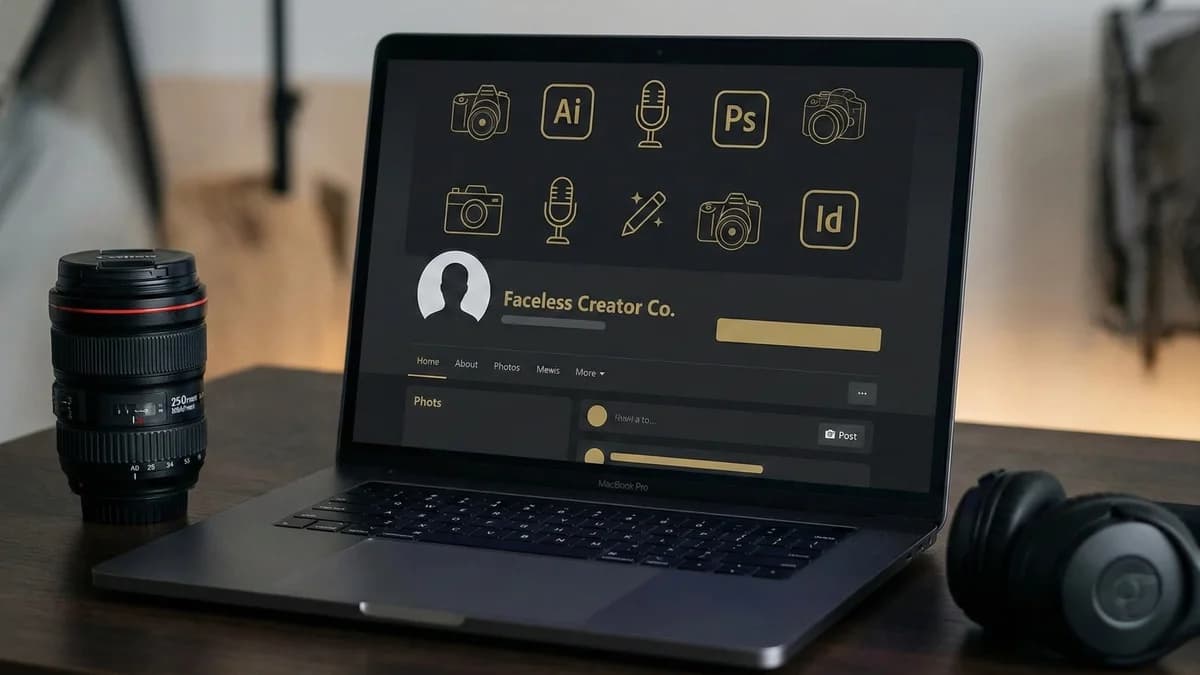
Not every successful social media brand needs a face behind it. Some of the most followed accounts on Instagram, TikTok, and YouTube are completely faceless: no personal identity, no on-camera presence, just compelling content delivered consistently.
These faceless brands generate real revenue through sponsorships, affiliate marketing, digital products, and ad revenue, all without the operator ever stepping in front of a camera.
If you want to build a social media business without tying it to your personal identity, this guide covers everything from choosing a niche to scaling content production.
What Is a Faceless Brand?
A faceless brand is a social media account that builds an audience around a topic, aesthetic, or content style rather than a personal identity. The operator is anonymous. Followers engage with the content itself, not with a specific person.
Examples of successful faceless brand categories include:
- Motivation and quotes: Accounts that post inspiring quotes, success stories, and mindset content over cinematic backgrounds.
- Luxury and lifestyle: Curated feeds of luxury cars, watches, homes, and travel destinations.
- Finance and investing: Educational content about stocks, crypto, and personal finance presented through graphics and screen recordings.
- Satisfying and oddly satisfying: Compilation accounts of satisfying videos that rack up millions of views.
- Niche knowledge: Accounts focused on history facts, science, psychology, or any topic where the content matters more than the presenter.
- Meme pages: Humor accounts that aggregate and curate the best memes in a specific niche.
Why Faceless Brands Work
Faceless brands have structural advantages that make them uniquely scalable:
- Not dependent on one person: A personal brand dies when the creator stops. A faceless brand is a system that can run indefinitely, be delegated to a team, or be sold entirely.
- Lower barrier to entry: No need for camera equipment, lighting setups, or on-camera confidence. You can start with a laptop and an internet connection.
- Multiple accounts possible: Since you are not tied to a face, you can operate 5, 10, or 20 accounts across different niches simultaneously.
- Privacy: Your personal identity stays separate from your business. No public exposure, no personal brand risk.
- Acquirable: Faceless accounts are easier to sell because the buyer does not need to replace a personality. The account continues operating the same way under new ownership.
Content Sourcing Strategies
The biggest question for faceless brands is: where does the content come from? There are several approaches, and most successful operators combine multiple sources:
1. Curated Reposts
The most common approach. Find high-performing content from other creators, download it, and repost it on your account. This is fast, scalable, and proven, but it comes with detection risks that we will address below. A popular variation of this is running a theme page on Instagram, where you curate content around a single niche.
2. Stock Footage and Free Assets
Use stock video sites, free photo libraries, and royalty-free music to assemble content. This works well for quote pages, motivation accounts, and educational content where you overlay text on background footage.
3. AI-Generated Content
Tools for generating images, videos, and voiceovers have matured significantly. AI-generated content can fill gaps in your posting schedule, but it rarely performs as well as real viral content from proven creators.
4. User-Generated Content
As your page grows, followers and other creators will start sending you content to feature. This creates a self-sustaining content pipeline and builds community engagement.
5. Cross-Platform Sourcing
Content that goes viral on TikTok often has not reached Instagram yet, and vice versa. By monitoring multiple platforms, you can be the first to bring trending content to a new audience. Once you have a library of source material, effective repurposing strategies let you turn each piece into several posts across formats.
The Repost Detection Problem
Here is the uncomfortable truth about faceless brands: most of your content is sourced from elsewhere. Whether you are reposting viral videos, curating photos from other accounts, or redistributing content across platforms, the material is not original in the eyes of the platform.
Social media platforms use three layers of detection to catch this:
- Metadata analysis: checking device information, timestamps, and file signatures to determine if a file was created on a real device or downloaded from the internet.
- Perceptual hashing: generating a visual fingerprint that survives crops, filters, and resolution changes.
- AI copy detection: deep learning models (like Meta's SSCD) that compare learned visual features rather than surface-level pixel patterns.
When your content matches an existing upload, the platform reduces your reach, shadowbans your account, or removes the content entirely. For a faceless brand that depends on volume and consistency, even a temporary shadowban can destroy weeks of growth.
How to Scale Without Creating Every Post from Scratch
The reality is that creating 100% original content for 3-5 daily posts is not feasible for most faceless brand operators. The economics do not work. You need a way to source content efficiently while ensuring every upload is treated as unique by the platform.
This means modifying sourced content at a fundamental level. Not surface-level edits like filters and crops that modern AI sees right through, but modifications that change how the file is identified at every layer: metadata, visual fingerprint, and AI feature representation.
MetaGhost: The Essential Tool for Faceless Brands
MetaGhost was designed for exactly this workflow. It takes any sourced file (downloaded video, curated photo, cross-platform content) and transforms it into something that registers as completely original to every detection system.
Each file gets authentic device metadata (as if shot on a real iPhone or Samsung), pixel-level modifications that change its perceptual hash without visible quality loss, and adversarial AI perturbations that make the content unrecognizable to copy detection models while remaining visually identical to humans.
For faceless brand operators, this means you can:
- Post 5+ times per day without worrying about shadowbans or reduced reach.
- Repost the same viral content that dozens of other accounts are sharing, and still have yours treated as original.
- Operate across multiple platforms simultaneously, with each version of the same content being unique per platform.
- Scale to multiple accounts and niches without detection cascading between them.
One often-overlooked piece of the puzzle is link protection. Faceless brands monetize through bio links (affiliate offers, digital products, landing pages), and a flagged or shadowbanned link kills your revenue overnight. LinkScale keeps your bio links safe with cloaking, multi-domain rotation, and deep links that bypass in-app browsers, so your traffic flows uninterrupted regardless of how many accounts or platforms you operate.
Ready to build your faceless brand the right way? Get started with MetaGhost and scale your content operation without limits.
Frequently Asked Questions
Can a faceless account still grow quickly?
Yes. Growth on most short-form platforms is driven by content relevance and consistency, not by a visible creator. A tightly-scoped niche with a repeatable format can grow as fast as a personal-brand account.
What niches work best for faceless social media brands?
Themes where the value is in the content itself (education, motivation, curated clips, tutorials, aesthetics and commentary) since they do not depend on a recognizable person.
How do faceless brands make money?
Typically through a link-in-bio hub pointing to affiliate offers, digital products, sponsorships or a newsletter, so the audience can be monetized without the creator appearing on camera.
Help us improve
Did this guide solve your problem?
Ready to create your next repost?
Try MetaGhost and make every repost unique and undetectable.
Discover MetaGhostRelated Articles
UGC Content: How to Repurpose User-Generated Content Legally
What UGC is, the legal framework for repurposing user-generated content, how to collect it at scale, and how to solve duplicate detection issues.
How to Post the Same Content on Multiple Platforms
Why cross-posting triggers duplicate detection, how platforms share fingerprint databases, and techniques to make each upload unique per platform.
10 Content Repurposing Strategies That Actually Work in 2026
Maximize your content ROI with 10 proven repurposing strategies. Turn one piece of content into dozens of unique posts without triggering detection.
How to Grow a Theme Page on Instagram in 2026
Build a profitable Instagram theme page from scratch: curate viral content, avoid duplicate detection, and scale to thousands of followers.
The Complete Guide to Cross-Posting on Social Media in 2026
How to cross-post across Instagram, TikTok, Facebook and more without triggering duplicate detection. Best practices and how to make each version unique.
How to Run 20 Instagram Accounts Without One Link Banning Them All (2026/2027 Guide)
Here is how the mechanism works, why it takes down accounts in groups, and the setup that keeps them separate.