How to Avoid Duplicate Content Penalties on Social Media

In brief
On social media, duplicate content penalties mean reduced reach and shadowbanning when platforms detect recycled uploads, not the Google SEO concept. Avoiding them means making each upload unique at the file and signal level and refreshing metadata, so duplicate-detection systems treat your content as original rather than recycled.
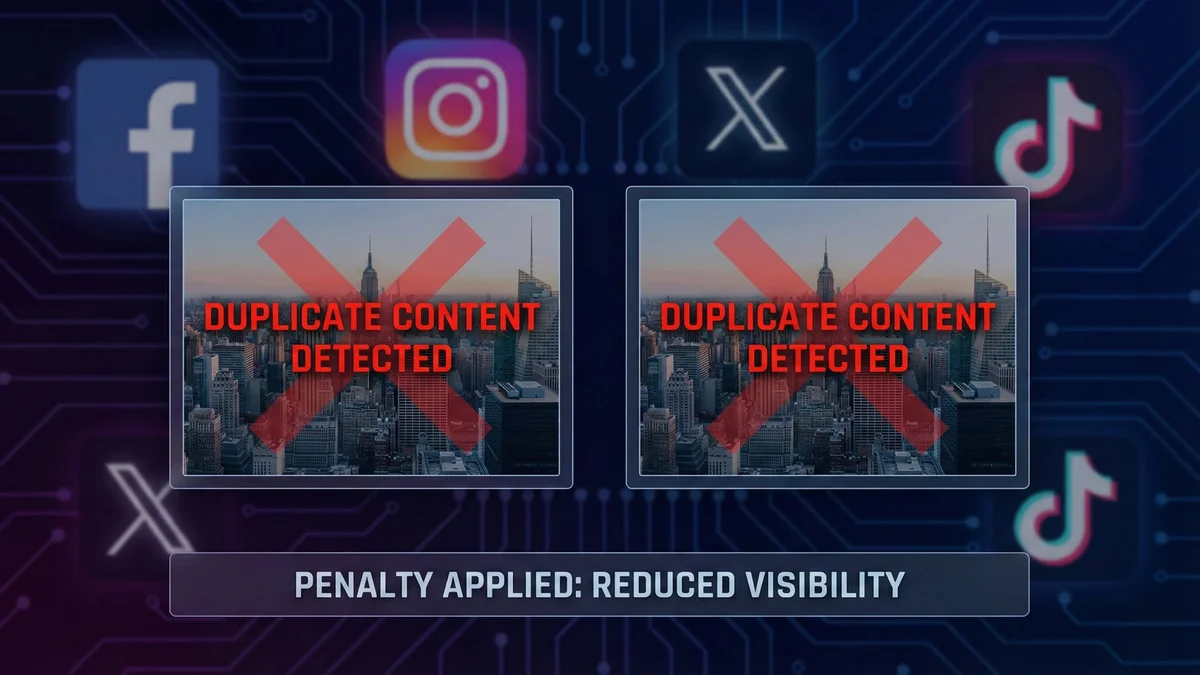
Duplicate content penalties are one of the biggest threats to social media growth, especially if you manage theme pages, curate content, or cross-post across platforms.
When a platform detects that your upload matches existing content, the consequences range from reduced reach to outright removal, and you may not even know it happened.
This guide covers what duplicate content penalties actually are, how each major platform handles them, and the concrete steps you can take to keep your content visible.
What Are Duplicate Content Penalties?
A duplicate content penalty is any negative action a platform takes when it determines your upload is a copy of existing content. This is not always a formal "strike" or takedown. In many cases, the penalty is invisible, and your post is simply shown to fewer people, excluded from recommendations, or deprioritized in the feed. This is commonly known as a shadowban.
The distinction between shadowbanning and removal is important. A removal means your content is taken down and you are notified. A shadowban means your content stays up but reaches almost nobody. Removals are obvious; shadowbans are silent, and many creators operate under a shadowban without ever realizing it.
How Each Platform Handles Duplicates
Instagram uses Meta's SSCD (Self-Supervised Copy Detection) model along with perceptual hashing to identify duplicate images and videos.
When a match is found, Instagram's first action is typically algorithmic suppression rather than removal. Your post will appear on your profile but will receive dramatically reduced distribution: fewer Explore placements, lower ranking in hashtag results, and reduced visibility in followers' feeds.
Repeated violations can lead to features being restricted (no Reels, no suggested posts) or account-level shadowbanning. Only explicit copyright claims from rights holders trigger actual removal.
TikTok
TikTok employs an AI-based detection system with an approximately 85% similarity threshold. If your video is flagged as substantially similar to existing content, TikTok will suppress it from the For You Page.
Since the vast majority of TikTok reach comes from the FYP, being excluded from it effectively makes your content invisible. TikTok also uses audio fingerprinting, so even if the visual content is different, using the same audio track as a copyrighted video can trigger suppression.
Facebook uses Rights Manager and SSCD for duplicate detection. Video reposts are particularly scrutinized because Facebook has been aggressive about protecting original video creators since its "freebooting" controversy.
When a duplicate video is detected, it may be removed entirely if the original creator has registered it in Rights Manager. Even without a registered claim, Facebook's algorithm deprioritizes content it identifies as non-original. Pages that consistently post duplicate content see their overall reach decline, affecting all their posts.
YouTube
YouTube's Content ID system is the most comprehensive in the industry. It scans both audio and video fingerprints against a massive reference database. Matches can result in the video being blocked, the audio being muted, or the video being monetized by the rights holder instead of the uploader.
Beyond Content ID, YouTube also penalizes channels that receive too many duplicate or reused content flags by limiting their eligibility for the YouTube Partner Program and reducing recommendation visibility. YouTube Shorts has its own duplicate detection layer that specifically targets reposts from TikTok and Instagram Reels.
Signals Platforms Look For
Understanding what triggers detection helps you understand why simple edits fail. For a deeper look at these systems, see our breakdown of how social media platforms detect duplicate content. Platforms analyze content at multiple levels:
- File metadata: Identical EXIF data, creation timestamps, or stripped metadata (which flags the file as a download rather than original capture) are early signals.
- Perceptual hashes: A compact fingerprint derived from the visual content. Survives cropping, resizing, color adjustments, and compression. Two images that look similar to a human will typically have similar perceptual hashes.
- AI feature embeddings: Deep learning models extract high-level feature representations from content. These embeddings capture the semantic meaning of an image, not just its pixels. A cropped, filtered, and resized version of a photo produces nearly identical embeddings to the original. This is the hardest layer to bypass.
- Audio fingerprints: For video content, audio is fingerprinted independently. Pitch shifting, speed changes, and background noise addition are all handled by modern audio matching systems.
- Upload patterns: Rapid consecutive uploads of similar content, posting the same file to multiple accounts, or uploading content that has already been widely distributed are behavioral signals that increase scrutiny.
Proactive Steps to Avoid Penalties
Here are the most effective strategies, ranked from basic to advanced:
1. Add genuine value to curated content
If you are reposting, add original commentary, a unique introduction, or context that transforms the content. Platforms reward originality, and content that adds value is treated differently by recommendation algorithms even if the underlying media is similar.
2. Use platform-native creation tools
Record, edit, and publish within the platform's own tools when possible. Content created natively carries metadata signatures that the platform trusts. A Reel created in Instagram's editor is treated differently than an uploaded video file.
3. Vary your content format
Do not post the exact same file to Instagram, TikTok, Facebook, and YouTube. Each platform has different aspect ratios, compression standards, and detection systems. At minimum, export different versions of your content for each platform.
4. Space out your uploads
Rapid-fire posting of similar content is a behavioral signal that increases algorithmic scrutiny. Maintain a consistent but measured posting schedule rather than batch-uploading curated content.
5. Modify content at the detection level
This is the only approach that addresses all detection layers simultaneously. Surface-level edits like filters, crops, and speed changes do not fool AI-based detection systems. To actually prevent a match, the content must be modified in a way that changes its fingerprint at the metadata, hash, and AI feature level.
The MetaGhost Approach
MetaGhost was built specifically to solve the duplicate content penalty problem. It operates on all three detection layers at once:
- Metadata layer: Injects authentic device metadata (camera model, GPS, timestamps) so the file appears as original capture rather than a re-upload.
- Hash layer: Modifies pixel values, compression, and resolution to break perceptual hash matches without visible quality loss.
- AI layer: Applies adversarial perturbations that are invisible to the human eye but completely change the content's feature embeddings. To detection models like Meta's SSCD, the processed file appears as entirely different content.
The result is that every upload looks like original, freshly-captured content to the platform's detection systems. No shadowban, no suppression, no penalties.
Ready to stop losing reach to duplicate content penalties? Try MetaGhost and make every post count.
Frequently Asked Questions
Is duplicate content a real penalty on social media?
Yes, but as reach suppression rather than a formal penalty. Platforms quietly limit distribution of content they identify as duplicated or recycled.
Is this the same as Google's duplicate content?
No. Google's duplicate content is an SEO indexing concept for web pages. On social media it is about platforms down-ranking reposted or recycled media.
How do I avoid reach suppression from duplicates?
Uniquify each upload at the file and signal level and give it fresh, realistic metadata so it is not recognized as a recycled duplicate.
Help us improve
Did this guide solve your problem?
Ready to create your next repost?
Try MetaGhost and make every repost unique and undetectable.
Discover MetaGhostRelated Articles
How to Bypass Social Media Content Detection in 2026
A complete breakdown of every detection layer platforms use (metadata, hashing, and AI models) and the only approach that defeats all three simultaneously.
How to Repost on X (Twitter) Without Getting Shadowbanned
How X/Twitter detects duplicate media, how shadowbanning works (search ban, ghost ban, reply deboosting), and how to repost safely.
How to Repost on YouTube Without Copyright Strikes in 2026
How YouTube Content ID fingerprints video and audio, why re-encoding fails, and how adversarial AI bypasses copyright detection for compilations.
My Post Was Removed for Copyright: What to Do
Why platforms remove posts for copyright, how Content ID and Rights Manager work, how to appeal, and how to prevent future takedowns.
Why Your Reposts Get Shadowbanned (And How to Fix It)
What shadowbanning really is, how platforms use it against reposts, and proven methods to avoid silent suppression on Instagram, TikTok, and Facebook.
How to Repost Videos on Facebook Without Detection
How Facebook uses SSCD and Rights Manager to flag video reposts, why traditional tricks fail, and how adversarial AI makes your uploads undetectable.